
The power and potential of AIM as a driver of CGT-free VCT growth
Dr Stuart Rollason, Investment Director | March 2025
In this article, Dr Stuart Rollason, Investment Director, looks at the Alternative Investment Market's (AIM) role in enhancing growth and productivity and why now is a good time to consider investing in AIM.
Supporting growing SMEs
Many of those companies leverage their presence on a London Stock Exchange to drive business development, including international sales. It’s no surprise then, that Grant Thornton’s September 2024 report, The economic impact of AIM companies, describes the market as having “an important role to play in the funding continuum, by enabling companies to raise external finance” as well as offering a “particularly beneficial environment for companies closer to the start of their growth journey”.
The ongoing growth culture is reflected in AIM companies that have an impressive record of growth, both immediately following IPO and year on year, with increases in revenue and employees.
Average annual revenue growth by post-IPO year, by market cap at listing
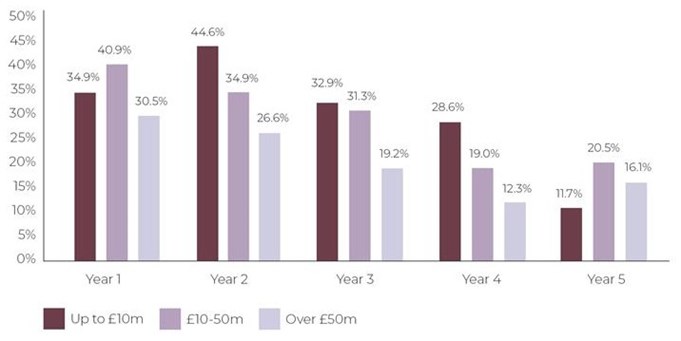
Source: Grant Thornton, analysis of LSEG Datastream data, 2024
One reason for this is that, even before becoming AIM-quoted, there are compulsory processes to be undertaken as part of the preparation for IPO, that enhance and strengthen the business’s operations. They include financial disciplines that underpin public company reporting (requiring the accounts to be fully audited) and the adoption of a recognised corporate governance code.
Productivity and resilience
With AIM companies, on average, being substantially more productive than the national average1, the market currently represents great value. Daily trading also means pricing is transparent and current, which translates to less risk of inaccurate valuations than is typical among unquoted VCT companies, where evidence for the basis of what investors pay for the shares is much less readily available. While Financial Advisers are generally fully aware of the volatility that can impact AIM shares, they may not be so cognisant of the quick recovery capabilities of the market after the steepest falls.
For instance, although it saw a drop to its lowest level in five years from mid-February to mid-March 2020, the bounce back was swift; just over 13 months after this dramatic fall, AIM was trading at record levels – breaking the 1,250 score for the first time in its history. In fact, AIM outperformed the FTSE main markets in 2020 by a substantial margin2.
Unquoted VCTs’ underlying companies are normally valued only every six months, which clearly gives the impression of lower volatility than something valued daily. There is a misconception that higher volatility on AIM means the VCTs themselves are higher risk. This is incorrect. Unquoted company risk relative to AIM listed is significant (as per the valuation and governance points above), and often AIM VCT qualifying companies are more developed than their unquoted counterparts, and data suggests that the average proportion of profitable companies across AIM VCTs being markedly higher3.
Why now?
Current growth prospects are enhanced by historic lows on established metrics, such as price to earnings (P/E) ratios. In December 2024, the market was trading on an average forward P/E ratio of around 11x, which is very cheap relative to its previous records, according to Bloomberg (Cavendish Capital Markets).
What’s more, interest rates have dropped three times since August 2024 to 4.5%, and if UK growth continues to stagnate in 2025, as it did in H2 2024, with inflation continuing its slow fall, interest rates could continue to drop. Add to that the expected expansion of the economy by between 0.7%4 and 2%,5 and it’s clear that companies are growing and conditions are favourable for smaller businesses. They tend to perform better over time in a falling interest rate environment, as the cost of capital falls, and, potentially, other costs stabilise or fall, with inflation having fallen from peaks in 2023.
AIM VCT investors could reap the rewards of tax-free growth that is further bolstered by the progress of the Mansion House Compact – a voluntary agreement between the UK’s largest defined contribution (DC) pension schemes to allocate at least 5% of their default funds to unlisted equities by 2030. It’s been estimated that the Compact could unlock up to £50 billion of investment into high-growth companies6.
Future drivers
Currently, pension assets held stand at £219 billion. In July 2024, it was announced that the 11 signatories of the Compact held nearly £793 million of unlisted equity assets in their DC default funds, or the equivalent of 0.36% of the total value of these funds7. To reach 5% of that will require more than £10 billion of additional investment, which would equate to exit routes for AIM listed companies and capital that could encourage more companies to list, but also possible AIM VCT deal flow competition, potentially driving up valuations over the medium term.
Introducing Puma AIM VCT
The first new AIM VCT brought to the market in 17 years
We believe that attractive valuations, with the potential to deliver tax-free growth and dividends through a publicly scrutinised market, make AIM a great place to invest through an experienced, specialist investment manager with a strong record for outperformance.

Sources
1 Economic impact of AIM, Grant Thornton, September 2025
2 London Stock Exchange, FTSE Index Records and Daily Closing Values, 1 October 2021 and London Stock Exchange’s (LSE) Secondary Market factsheet for September 2021
3 Apex Investment Consultancy, Allenbridge VCT Report, 2023-25
4 Bank of England Monetary Policy Committee, 19 December 2024
5 Office for Budget Responsibility, Economic and Fiscal outlook, October 2024
6 Chancellor’s Mansion House Reforms to boost typical pension by over £1,000 a year, HM Treasury, 10 July 2023.
7 Reuters, Still 'early stage' of UK efforts to tap pension pots for growth, 30 July 2024.