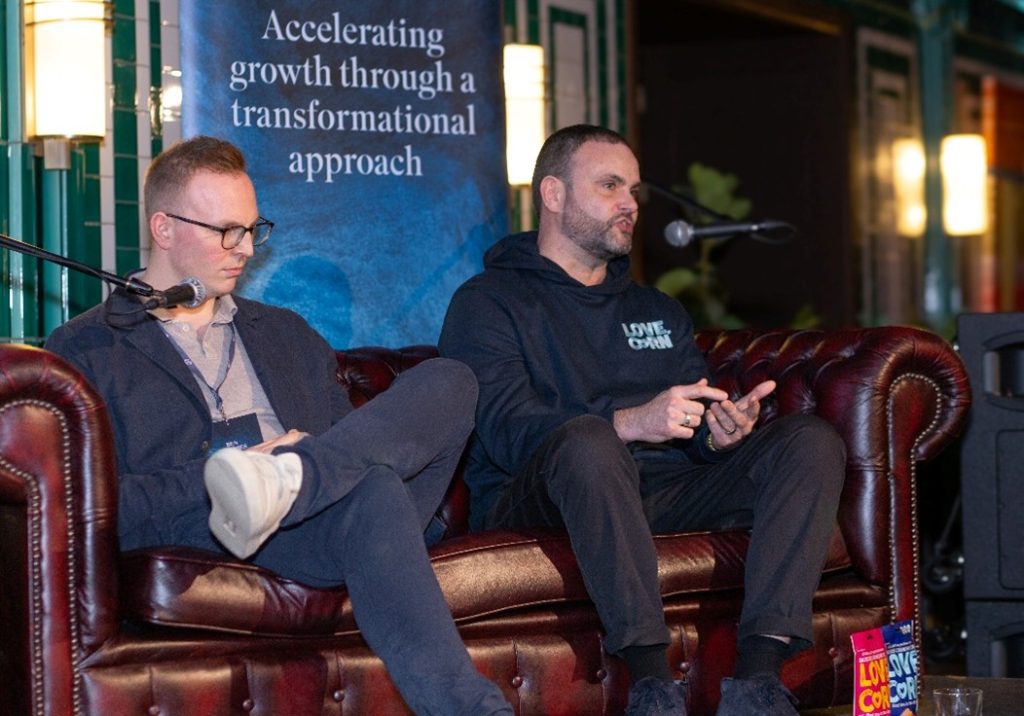
Going global – lessons from LOVE CORN and Influencer
At this year’s Portfolio Conference, Henri Songeur, Investment Director, hosted a session on international expansion bringing together two portfolio founders who have done it for real: Jamie McCloskey, co-founder of LOVE CORN and Ben Jeffries, co-founder and CEO of Influencer. The discussion focused on what actually moves the dial when a UK scale‑up steps onto a bigger stage.
Why expand, and when
Both speakers were clear that expansion is a strategic decision, not a marketing moment. The US is attractive, but only if the fundamentals stack up. For LOVE CORN (we invested in the business in 2025), the crunchy corn snack brand sold in over 20,000 stores across the UK and US, the decision was grounded in “white space” and unit economics. The team validated there was room for a mainstream, allergy‑friendly snack and that US gross margins could sustain the cost of doing business at scale. Influencer (who we backed in 20219), the global influencer marketing agency working with brands including Coca-Cola, Google, Nike and Samsung and with offices in the Middle East, the US and Europe, took a similar approach to services. The US is the world’s largest advertising market, but Influencer’s strategy had to follow a plan, not a hunch. That meant waiting until leadership, budget and client demand were in place, rather than a half‑step that would vanish in the noise.
Design for scale, then simplify
LOVE CORN built brand, product and flavour profiles that worked in both the UK and the US, simplifying the supply chain and keeping 80-85% of marketing consistent across markets. The aim was a universal proposition that could land anywhere – such as a Costco in Watford or in Dallas, solving the same consumer need. For a services business, the equivalent is a repeatable offer. Influencer targets enterprise brands with briefs big enough for dedicated teams, then uses platform partnerships and existing client relationships to seed work in new territories.
Commit, or conserve
Both speakers stressed the cost of entering the US. If you spread spend too thinly, it has no material impact. The better route is to pick your spot and commit. Influencer backed a proven US leader before committing further. It also avoided the biggest trade shows initially, choosing niche events where conversations were higher intent and competitors were absent, building case studies that travelled.
Hire for mindset, act fast on mis‑hires
Logos on a CV can be seductive but they are not a proxy for cultural or organisational fit. LOVE CORN now screens for four traits across the UK and US teams: ‘do they care, are they curious, do they have a can‑do attitude, do they show common sense’? The right hire, for example a seasoned CFO, can be a game‑changer that pays for itself by improving visibility, pace and decision quality.
Decide, then move
Decision paralysis kills momentum. Influencer’s rule is to “commit and disagree in the room”. Make the call, align, and execute. You will course‑correct faster in market than you will debating hypotheticals.
Operating discipline scales culture
International growth stretches culture and communication. Diversity of thought across offices is an asset if there is a shared system. Influencer credits the Entrepreneurial Operating System with giving every team a clear line of sight from vision to three‑year and one‑year goals and values, creating a common language for execution across regions.
Five practical takeaways:
- Prove the economics first. Validate white space and margin structure in the target market before you spend on presence.
- Standardise what you can. Build products and propositions that travel, then localise only where it truly matters.
- Enter with intent. Choose one market, one leader, one channel, and commit enough resource to be noticed.
- Hire for attitude as well as pedigree. Act quickly on mis‑hires. The right senior hire can change the trajectory.
- Institutionalise execution. Adopt an operating system so distributed teams pull in the same direction.
International expansion is not a single leap. It is a series of deliberate moves that add up. As our portfolio shows, many UK scale‑ups are already building meaningful overseas footprints, with the US a common next step.